Workshops
Formats
At the PMC we tailor the design and format of the workshop to the audience and the issue. No two workshops are the same.
The Pam McLean Centre specialises in creating teaching workshops that allow participants to have individualised learning experiences and peer feedback. We explore the structure of, skills involved in, and psychology around health based interactions.
Under the guidance of expert facilitators, and professional actors from The Pam McLean Centre, this hands-on, interactive learning opportunity will not only increase your knowledge and skills in communicating, but your understanding and interpretation of human behaviours, and the value of good communication within the health system. Our workshops are designed to provide safe learning environments for health professionals.
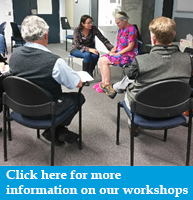
The Time Out model is used to allow the role play to be paused and participants can share feedback and ideas in a peer learning model. In each part of the conversation, insight into the experience of the clinician and patient involved is also highlighted. The scenarios can explore multiple issues, and are flexible to the needs of the group.
If you know our work well and are interested in running workshop(s) with the Pam McLean Centre, please feel free to click the button below to fill out an enquiry form. Or see below first for details on scenarios and sample workshop styles.
Simultaneous Scenarios
The Simultaneous Scenarios format allows participants to work intensively in small groups on different aspects of professional engagement. Between two and six scenarios are run simultaneously in different rooms. Each scenario explores a different aspect of the professional issues that are being examined. Across the course of the workshop participants have the opportunity to engage with each scenario and compare results at the conclusion. This is most commonly adopted for large numbers of trainees.
Multi-Scenario
The Multi-Scenario format is used for workshops in which a communication issue involves multiple challenging discussions. In liaison with the client we develop a series of different scenarios that may be a series of role-plays that track a chronological progression through an unfolding situation. Alternatively the scenarios may be a series of stand-alone interactions that allow for exploration of the varying communications involved (or to explore scenarios that occur over a long time span). Participants work collaboratively to explore how each situation could be handled and discussion amongst participants is encouraged and guided by an experienced facilitator.
Learning Styles
The Multi-Scenario format can be run in conjunction with the Centre’s Learning Styles workshop, which explores in a very interactive format the different problem-solving approaches of participants and how they interact with clinical decision-making.
Open Chair
An Open Chair format is used in short workshops to maximise the engagement of each participant with the role-play actor/patient. Guided by an experienced facilitator the workshop begins with the participants asking the role-play character questions about their medical or professional history in order to build a picture of the issues at play. Then the group works collaboratively, with participants taking turns to role-play with the actor, and the rest of the group offering suggestions and engaging in discussion as the role-play progresses.
Evolving Scenario / Hypothetical
In the Evolving Scenario or Hypothetical format, the workshop progresses through a series of consecutive scenarios with one or more actors playing patients, family members, or any other character relevant to the situations. At any point the focus can be held on one instant or interaction in the progressive “story” if desired, or can divert into a scenario that the participants would like to explore. This is a very open style workshop that allows for broad as well as intensive exploration of the issues.
Videos
We write scripts and produce DVD/video content for particular issues of communication. Using our skilled actors, and our knowledge of key communication issues and outcomes, as well as a strong background in film production, we can tailor DVD/video content to reflect the needs of the client, in realistic filmic style videos.
Samples
Dealing with Bad News
This workshop allows participants to explore approaches for supporting patients who are dealing with bad news. Patients who are processing bad news about their diagnosis or prognosis typically react with a complex array of emotional responses. Under the guidance of an experienced facilitator, this workshop helps participants to recognise, identify and respond empathically to the most common emotional reactions.
Breaking Bad News
These advanced workshops are designed to explore the difficult issues involved with telling somebody bad news about diagnosis, prognosis or the death of a family member. Imparting this type of bad news to a patient, or their family, is extremely difficult and often distressing for everybody involved. These workshops are designed to empower participants with tools and approaches that can help them to empathically approach these issues. The workshops build on a body of postdoctoral research conducted by the Centre.
Aversive Procedures
This workshop equips participants with skills and tools for discussing aversive procedures with patients. An aversive procedure is one that is scary, unpleasant, confronting or painful for a patient. Working with a facilitator the participants explore methods of communicating with patients about necessary but unpleasant medical procedures. The workshop highlights the importance and power of word choices, language techniques and active listening in all conversations with patients.
Open Disclosure
This workshop focuses on issues associated with mistakes and adverse events in the healthcare system and our professional conduct in response to them. Participants are given the opportunity to explore their own fears and reactions, as well as finding optimal ways to communicate and respond to the reactions of patients, their families and other health professionals. This high level complex interaction deals with multiple problems in a diverse array of relationships.
Supervision
The role of educator and supervisor is one many find themselves in without the skills to create safe and effective learning environments for their students or trainees. This series of workshops aims at improving communication between supervisors and their students/ trainees. It is adapted for either research or clinical supervisors in an academic, specialist training or hospital environment.


 Pam McLean Centre